REPRODUCTIVE ORGAN SURGERIES
Urology is not only about complex operations and long-term treatment.
Today, many male and female health problems can be solved quickly, painlessly and without the need for hospitalization.
Our department performs a wide range of quick, minimally invasive procedures that significantly improve quality of life.
After them, the patient can usually return home the same day.
Such interventions are aimed at eliminating functional or aesthetic problems, improving hygiene and preventing complications in the future.
In particular, doctors of our department perform procedures that will help you get rid of such problems as:
- -Phimosis – narrowing of the foreskin (treatment – circumcision);
- -Small skin or mucosal growths (papillomas, condylomas, etc.);
- -Short penile frenulum;
- -Spermatic cord or scrotal cyst;
- -Hydrocele (testicular dropsy);
How does the procedure work?
1. Consultation with a urologist, during which the need for intervention is determined.
2. Tests and examinations (if needed).
3. The operation itself.
4. Observation after the procedure and discharge.
5. Follow-up examination in a few days.
Frequently Asked Questions:
Is it painful?
No. Local anesthesia or general anesthesia is used – you do not feel pain during the intervention.
No. Local anesthesia or general anesthesia is used – you do not feel pain during the intervention.
Do scars remain?
Scars after minor surgery are usually inconspicuous or minimal.
Scars after minor surgery are usually inconspicuous or minimal.
Do I need to prepare for the procedure?
The doctor will provide clear individual recommendations before the intervention.
The doctor will provide clear individual recommendations before the intervention.
1. Circumcision: when it's needed, how it works, what to expect:
Circumcision is the surgical removal of the foreskin (the skin fold covering the glans of the penis).
This is one of the most common and safe urological procedures, which can be performed for medical, hygienic or cultural reasons.
Main indications for circumcision:
-Phimosis – narrowing of the foreskin that prevents full opening of the penis glans
-Paraphimosis – pinching of the foreskin behind the glans (emergency condition);
-Chronic inflammation (balanoposthitis) that does not respond to medical treatment;
-Prevention of urogenital infections (especially with frequent recurrences);
-Hygienic or religious considerations;
-Problems during sexual life due to short frenulum or phimosis
What types of circumcision exist?
Depending on tissue condition, patient age and preferences, the doctor may suggest one of the operation variants:
1. Complete circumcision
All foreskin is removed, glans remains fully exposed. Most commonly used for phimosis.
2. Partial circumcision
Only part of the foreskin is removed, glans remains partially covered. Used less often, mainly for aesthetic reasons.
3. Classic surgical technique (scalpel)
Performed using scalpel or scissors under local anesthesia. Most common method.
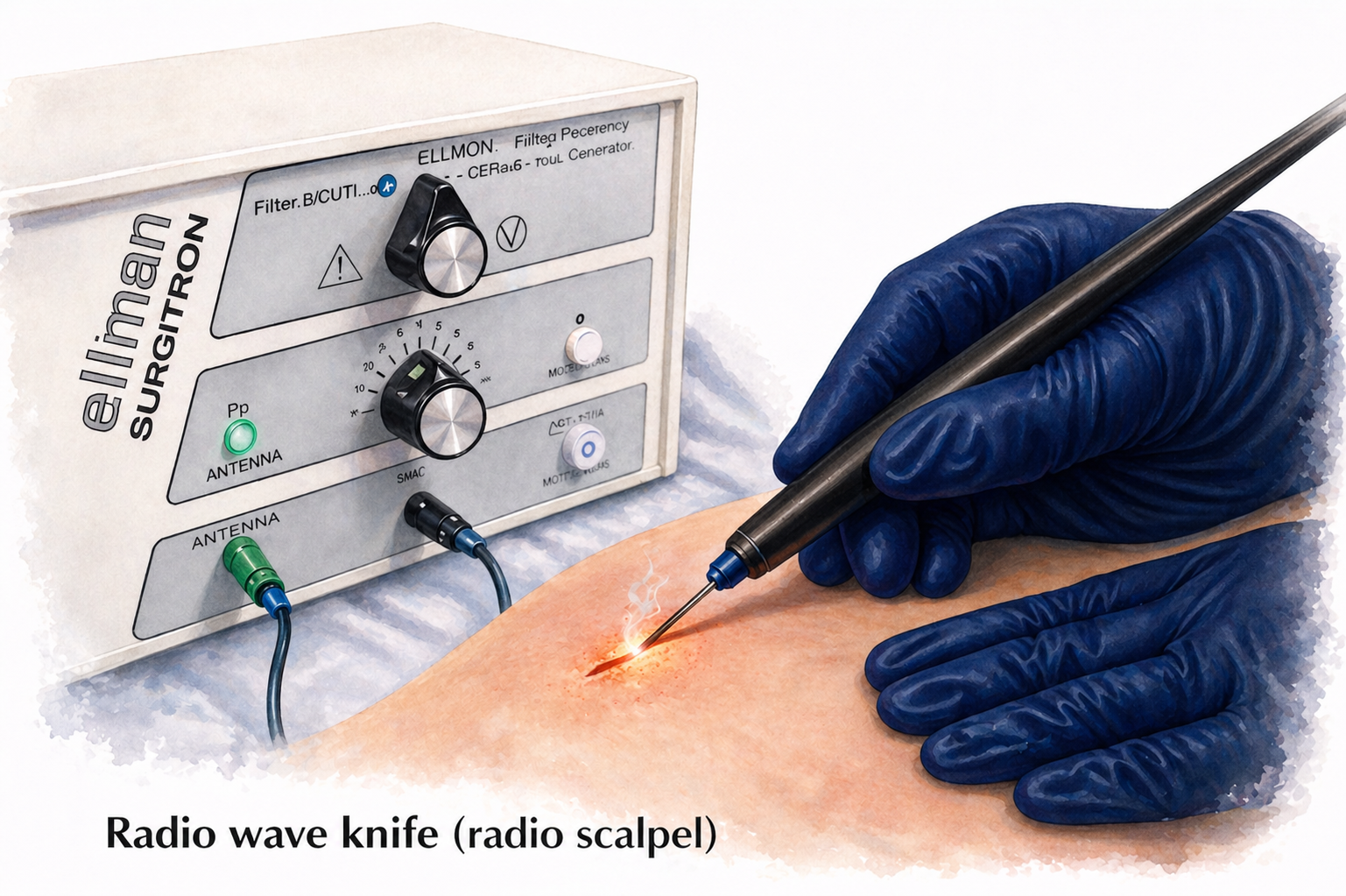
4. Circumcision using radiowave knife
Modern, minimally traumatic technique. Less bleeding, less swelling, faster healing.
5. Circumcision with or without sutures
In some cases, special techniques are used that do not require sutures (for example, using a clamp or ring in children)
Benefits of circumcision:
-Improved hygiene
-Reduced risk of infections
-Facilitation of sexual life (with phimosis, short frenulum)
-Prevention of certain diseases (for example, reduced risk of HPV and HIV in some studies)
-Aesthetic effect (upon patient request)
Recovery after surgery
-First 1–3 days – possible swelling, slight discomfort
-Painkillers and antiseptic agents are prescribed
-Hygiene – daily treatments as recommended by doctor
-Suture removal (if not self-dissolving) – usually on day 7–10
-Return to sexual life – approximately after 3–4 weeks
Frequently asked questions:
At what age is it better to do circumcision?
The procedure can be performed in both childhood and adulthood. In adults – more often for medical reasons.
Does circumcision affect sexual life?
Yes, but usually positively – discomfort and pain decrease, confidence increases. Sensitivity may change slightly, but this usually does not reduce the quality of sexual life.
Circumcision is the surgical removal of the foreskin (the skin fold covering the glans of the penis).
This is one of the most common and safe urological procedures, which can be performed for medical, hygienic or cultural reasons.
Main indications for circumcision:
-Phimosis – narrowing of the foreskin that prevents full opening of the penis glans
-Paraphimosis – pinching of the foreskin behind the glans (emergency condition);
-Chronic inflammation (balanoposthitis) that does not respond to medical treatment;
-Prevention of urogenital infections (especially with frequent recurrences);
-Hygienic or religious considerations;
-Problems during sexual life due to short frenulum or phimosis
What types of circumcision exist?
Depending on tissue condition, patient age and preferences, the doctor may suggest one of the operation variants:
1. Complete circumcision
All foreskin is removed, glans remains fully exposed. Most commonly used for phimosis.
2. Partial circumcision
Only part of the foreskin is removed, glans remains partially covered. Used less often, mainly for aesthetic reasons.
3. Classic surgical technique (scalpel)
Performed using scalpel or scissors under local anesthesia. Most common method.
4. Circumcision using radiowave knife
Modern, minimally traumatic technique. Less bleeding, less swelling, faster healing.
5. Circumcision with or without sutures
In some cases, special techniques are used that do not require sutures (for example, using a clamp or ring in children)
Benefits of circumcision:
-Improved hygiene
-Reduced risk of infections
-Facilitation of sexual life (with phimosis, short frenulum)
-Prevention of certain diseases (for example, reduced risk of HPV and HIV in some studies)
-Aesthetic effect (upon patient request)
Recovery after surgery
-First 1–3 days – possible swelling, slight discomfort
-Painkillers and antiseptic agents are prescribed
-Hygiene – daily treatments as recommended by doctor
-Suture removal (if not self-dissolving) – usually on day 7–10
-Return to sexual life – approximately after 3–4 weeks
Frequently asked questions:
At what age is it better to do circumcision?
The procedure can be performed in both childhood and adulthood. In adults – more often for medical reasons.
Does circumcision affect sexual life?
Yes, but usually positively – discomfort and pain decrease, confidence increases. Sensitivity may change slightly, but this usually does not reduce the quality of sexual life.
2. Removal of condylomas and papillomas:
Condylomas and papillomas are benign growths that appear as a result of viral infection. They can cause discomfort and psychological stress.
Removal of such growths is carried out using modern technologies – laser or radiowave method. The procedure is safe, painless and leaves no noticeable traces.
Condylomas and papillomas are benign growths that appear as a result of viral infection. They can cause discomfort and psychological stress.
Removal of such growths is carried out using modern technologies – laser or radiowave method. The procedure is safe, painless and leaves no noticeable traces.
3. Penile plastic surgery:
Plastic surgery is performed for curvature, trauma consequences or aesthetic indications.
Modern methods allow correcting shape, restoring symmetry and improving the appearance of the penis while preserving all its natural functions.
Such operations help not only physically but also psychologically – returning confidence to a man, and in complex cases, allowing a return to comfortable and quality sexual life.
Plastic surgery is performed for curvature, trauma consequences or aesthetic indications.
Modern methods allow correcting shape, restoring symmetry and improving the appearance of the penis while preserving all its natural functions.
Such operations help not only physically but also psychologically – returning confidence to a man, and in complex cases, allowing a return to comfortable and quality sexual life.
4. Treatment of testicular hydrocele (hydrocele)
Testicular hydrocele is an accumulation of fluid in the testicular membranes, causing the scrotum to increase in size, with possible feelings of heaviness or discomfort.
Modern minor surgery allows safe removal of hydrocele, restoring normal appearance and well-being. After the intervention, the patient recovers quickly and returns to normal life within a few days.
Testicular hydrocele is an accumulation of fluid in the testicular membranes, causing the scrotum to increase in size, with possible feelings of heaviness or discomfort.
Modern minor surgery allows safe removal of hydrocele, restoring normal appearance and well-being. After the intervention, the patient recovers quickly and returns to normal life within a few days.
5. Testicular prosthetics
In case of testicular absence (after trauma, surgery or congenital defects), installation of a special prosthesis is possible.
This procedure is mainly aesthetic in nature and helps restore scrotal symmetry.
In case of testicular absence (after trauma, surgery or congenital defects), installation of a special prosthesis is possible.
This procedure is mainly aesthetic in nature and helps restore scrotal symmetry.
- ✓Want to learn more or schedule a procedure? - Fill out the form below - and we will contact you for a consultation
- ✓We maintain complete confidentiality.
- ✓Trust your health to an experienced urologist.